



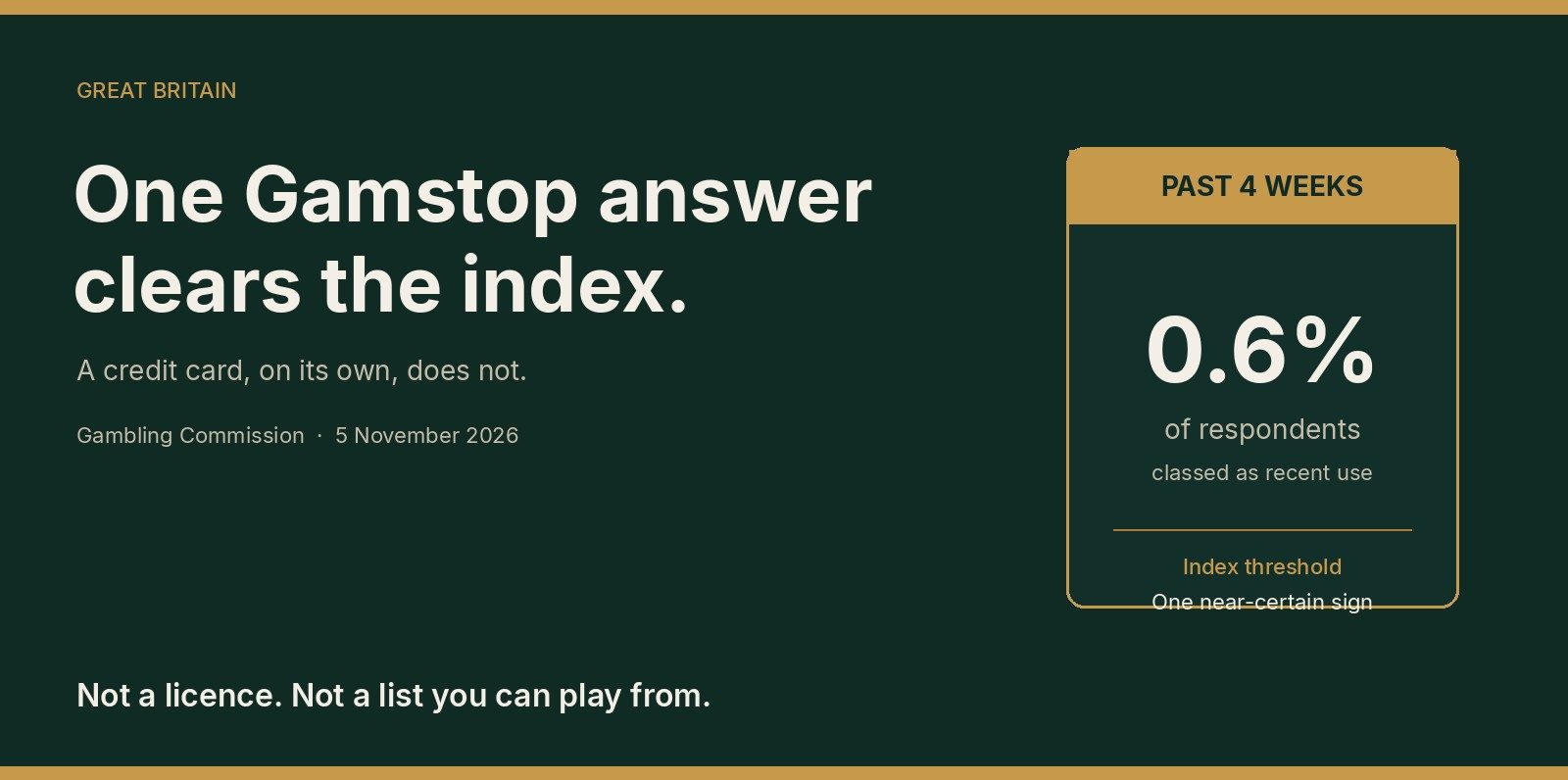
The Gambling Commission published its first Illegal Gambling Index on 5 November 2026. It classed 0.6% of respondents as having used an illegal gambling website in the past 4 weeks, and a further 0.4% in the past 12 months but not in those 4 weeks. Among people who gambled online in the past 12 months, leaving out anyone whose only online gambling was National Lottery products, those bands are 2.5% and a further 1.5%. The score is built from seven answers. It is not a list of sites you may use. A small share is not a reason to treat an unlicensed cashier as safe. You still cannot take a site that skips Gamstop, skips an identity check, or lets you cancel a withdrawal, and call it a Commission licence.
The questions sit in the Gambling Survey for Great Britain. The findings page dates the first year April 2025 to April 2026. The dashboard workbook titles the same table April 2025 to March 2026. This article does not invent a missing month. The index exists because the direct question does not work. The technical report says people often cannot tell a licensed site from an unlicensed one. In the pilot, almost everyone who claimed a recent illegal site either would not name it or named a licensed operator. Those questions were dropped. The score uses what you did, not your view of the law.
What clears the line, and what does not
The technical report, published the same day, rates three indicators as near certain. Each scores 3 if you say yes for the past 4 weeks. They are: you used a gambling website you knew was not on Gamstop; you signed up because you knew it would not check your age or identity; you cancelled a withdrawal before it reached your bank or wallet. Three more are strong, and each scores 2: a VPN used to open a gambling website that was not otherwise available in Great Britain; cryptocurrency, with Bitcoin given as the example; NFTs or other virtual assets. A credit card you can pay off monthly is the weak one. It scores 1, because people mix credit cards up with debit cards. The calculation table marks that row “weaker”.
A past-4-weeks yes keeps the full score. A past-12-months yes is halved. A memory older than 12 months is halved again. The raw points are then multiplied by 6.25, so a full house of 16 becomes 100. The past-4-weeks group is anyone with at least one near-certain indicator in that window, or two strong ones. One near-certain answer is a raw 3. Three times 6.25 is 18.75, which is the threshold the report names. One strong answer scales to 12.5. One credit-card answer scales to 6.25. Neither of those, on its own, puts you in the 0.6%.
The past-12-months group is what remains once halved scores are added and the total still reaches 18.75. One halved answer does not get there. If every indicator you report is older than 12 months, you stay in “limited indications” even where the reduced score would have cleared 18.75. You are not counted as an illegal-site user. The findings page puts 4.6% of respondents in that limited group, and 94.4% on no indication. The report says the limited group is there for completeness, and that discussion should stay on people who meet the threshold. Do not add 4.6 to 0.6 and call the sum the market.
Read the dashboard page with that rule in your hand. Its demand bullets say the 2.5% is among people who gambled online in the past 4 weeks. The workbook does not say that. The row is “Online gamblers (excluding lottery)”. The 2.5% sits in the column “Engaged in the last 4 weeks”, and the 1.5% in “Engaged in the last 12 months”. The findings page defines that base as online gambling in the past 12 months, excluding National Lottery-only play, and it calls the 1.5% a further band. Rupam Jagota’s blog the same day adds the bands and gets about 1% of all respondents over 12 months, and 4% of people who had gambled online. That addition is 0.6 plus 0.4, and 2.5 plus 1.5. This article follows the findings page, the blog and the workbook labels. It does not follow the dashboard sentence.
What a licensed site is still not allowed to do
The technical report says all licensed gambling websites are required to participate in Gamstop. That is why “not on Gamstop” was raised from a strong indicator to a near-certain one. Among people the index classed as illegal-site users, 58.0% reported that sign in the past 12 months, and 56.6% reported cancelling a withdrawal before it reached a bank or wallet. Those shares are of the classified group. They are not shares of the population. Sue Young, executive director for operations, said the population picture looks low and stable, and that research suggests the people who do use illegal operators are more likely to experience harm. That is her statement. It is not a finding that 0.6% is a safe remainder.
Licence condition 6.1.2 says a remote licensee must not accept payment for gambling by credit card. That includes a credit card routed through a money service business. The Commission’s own guide dates the ban to 14 April 2020. The 2021 decision on game design says remote technical standard 14B, in force from 31 October 2021, requires that you must not be given the option to cancel a withdrawal. The November 2026 report still dates that ban to 2021, and it still treats the button as near-certain evidence of an unlicensed site. An old credit-card memory can predate the ban. The report says so, which is why a “more than 12 months ago” answer is kept out of the user count. A button that works this week is a different fact.
A VPN, a crypto cashier, or an NFT does not become legal because the index wants two strong signs before it counts you. The strong rating means one of those answers is not, by itself, the Commission’s proof. It does not mean the site holds a licence. Skipping the age check is in the near-certain group for a reason. If the site will take you without proving you are 18, the licence system has already been left behind.
The 586 sites are a search list
The same release counts 586 illegal gambling websites accessible to consumers in Great Britain in September 2026. The method is a search on watched terms, a follow of affiliate links, a manual review, and a drop of any domain that was geo-blocked from the network used for the test. The page says this is not a complete count. A site that does not rank for those terms can still be illegal. Absence from the 586 is not a clearance.
The dashboard page says September was 4% below the previous three-month average and 4% above September 2025. The monthly cells in the workbook do not produce those two lines. September 2026 is 586. June, July and August 2026 are 613, 616 and 634. September 2025 is 587. This article uses 586. It does not repeat the 4% lines.
Affiliate pages, not affiliate firms, came to 97 in September. The page says that was 26% below the previous three-month average. June, July and August are 154, 131 and 107, which does land near that comparison. Two pages on one domain can both count. Of gambling-related Google results, the page says 4% led to an illegal domain in September, half a point above the previous three-month average. The September column is higher for casino queries: 5.25% of those results, against 3.94% for betting, 2.83% for general gambling and 3.80% for promotions. That is one setup, on one day, for one list of terms.
Estimated time on the identified sites was 12% higher in September than the previous three-month average, and 11% lower than September 2025. That is not a count of people. Estimated visits are multiplied by estimated visit length, then a VPN uplift is applied: 19% on the lower figure, 26% on the midpoint, 34% on the upper. The September midpoint cell is 150 million minutes. The lower cell is 97. The upper cell is 232. Search volume for terms the Commission illustrates with “Not on Gamstop” was 53% below the previous three-month average and 22% below September 2025. A search is not a session. A quieter search box is not a closed market.
Disruption is not the same as a shutdown
In the second quarter of 2026 to 2027 the Commission counts 311 distinct websites as disrupted. The action table for that quarter uses other units. It includes 1,835 websites referred to search engines, 7,677,211 URLs referred to search engines, and 546 cease-and-desist notices to operators. A referral is not a shutdown, and it is not the same thing as the 311.
The traffic figures wait a quarter, because they need three later months of estimates. The page dates them to the first quarter of 2026 to 2027. Of the disrupted sites with enough traffic data, 77% saw estimated traffic fall, and total estimated traffic on that set fell 18%. The page says you should not read the 18% as proof that disruption caused every change. It is not a closure rate for the 311 sites in the newer quarter.
What to do with the number
- Do not treat 0.6% as a green light. The denominator is everyone in the survey, including people who did not gamble. Among online gamblers, excluding lottery-only play, the past-4-weeks band is 2.5%.
- One of these, in the past 4 weeks, is enough for the index to class the respondent as a recent illegal-site user: you knew the site was not on Gamstop, you signed up because it skipped an age or identity check, or you cancelled a withdrawal before it reached your bank. Licensed sites have to be on Gamstop. They are not allowed to offer you that withdrawal button.
- A credit card, on its own, does not cross that line. Crypto on its own does not. A VPN on its own does not. None of the three is a Commission licence. Remote licensees have been barred from credit-card deposits since 14 April 2020.
- Do not add the 4.6% “limited indications” to the 0.6%. The report tells you not to. An old credit-card memory can date from before the ban.
- The 586 is a September search list of domains that loaded from the test network. It is not every illegal site, and a missing name is not a clearance. A catalogue on a bonus site is not the register.
- If you want a room that is allowed to take you from Great Britain, start with the licence and the country, as in how to choose an online casino in 2026. If gambling has stopped being entertainment, the Commission lists 0808 8020 133 in England and Scotland and 0808 2819 265 in Wales.
18+. Only a bankroll you can lose, and only where the operator is allowed to take you.
Sources: Gambling Commission news, 5 November 2026; Phase 4 findings; technical report, executive summary; calculating the index; reporting the findings; Gamstop participation, in the modification section; Rupam Jagota, 5 November 2026; Illegal gambling data dashboard, November 2026; workbook “Illegal gambling dashboard data tables — November 2026”, read 6 November 2026; LCCP 6.1.2; credit-card guide, ban dated 14 April 2020; RTS 14B, in force 31 October 2021. The dashboard’s “past 4 weeks” base for the 2.5%, and its 4% website comparisons, are flagged above and are not used as figures.
Published: 06. November 2026
Anything incorrect or missing?