



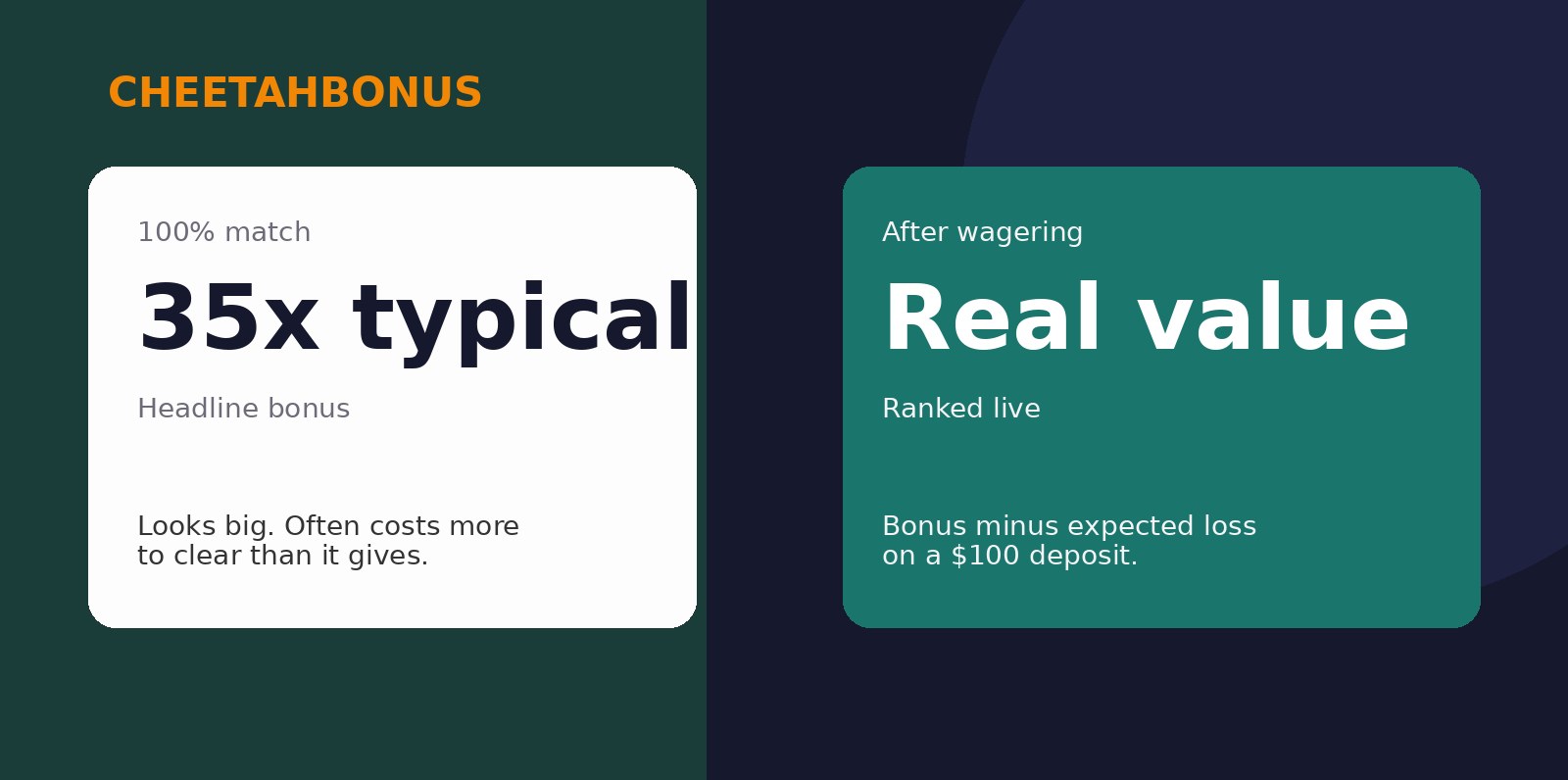
A “100% up to $500” banner tells you almost nothing. Two bonuses with the same headline can leave you with very different amounts once wagering, game rules and the house edge are in. CheetahBonus ranks offers on that remainder, not on the marketing line.
Three live tools do the work: the calculator on each bonus card, the CheetahBonus Wagering Index, and the best value casino bonuses ranking. This is how they fit together, and how to use them before you deposit.
The headline percent is not the offer
Take a $100 deposit and a 100% match. You receive $100 extra. If wagering is 35x the bonus only, you must bet $3,500 on slots before anything from the bonus is withdrawable. If the same 35x applies to bonus and deposit, you must bet $7,000. The banner was identical. The job was not.
That is why every CheetahBonus bonus card with a match percent and a wagering rule has a calculator. It uses that bonus’s own game list: pick slots or blackjack and it shows turnover, typical house-edge loss, and estimated value on your deposit. A bonus that looks smaller on the banner can come out ahead if wagering is lower, or if it applies to the bonus only.
What “normal” wagering looks like
One calculator result is still a single offer. The Wagering Index is the catalogue behind it: every active casino bonus we list that has wagering data, at casinos with a published review that are not closed or blacklisted.
It is recalculated from that live data at least every six hours. You can see the median lowest wagering, how many offers sit at 25x or less, how often the deposit counts too, and how exclusive codes compare with regular ones. Licence tiers match the Cheetah Score.
If a bonus asks for 45x on bonus and deposit, that is not a special deal. It is heavier than the middle of the market. If it asks for 20x on the bonus only, it is lighter than most of what we track.
Ranking by expected value, not by size
The best value page takes deposit-match bonuses and asks a blunt question: after you wager the bonus on the cheapest honest game in its own rules, is the extra money expected to cover the house edge, or not?
- Bonus: what a $100 deposit actually credits, capped at the maximum.
- Turnover: wagering times the amounts it applies to.
- Expected loss: turnover times a typical house edge for that game.
- Value: bonus minus expected loss.
Above zero, the average player is expected to be ahead of the house edge from the bonus. Below zero, the wagering costs more than the extra funds. We show one bonus per casino so a brand cannot flood the list. Maximum bet, time limits and winning caps are not in the formula, so you still read the full terms.
Where this sits in the Cheetah Score
A fair bonus does not make a casino safe to use. The Cheetah Score weights licence and payouts more heavily than bonus fairness. A 35x match at a casino with slow withdrawals is still a poor place to leave a win. Use the ranking to pick an offer, then open the review and read the score tracks before you claim it.
A short checklist before you claim
- Open the calculator on the bonus card. Check whether wagering is bonus only or bonus and deposit.
- Compare that multiplier with the live Wagering Index median.
- See if the casino’s best deposit match is on the value ranking.
- Read the Cheetah Score, especially payouts, on the casino review.
- Check maximum bet, time limit and any cap on winnings in the terms.
Gamble only with money you can afford to lose. None of these numbers is a promise that you will withdraw a win; they tell you whether the terms are lighter or heavier than the rest of the catalogue.
Published: 09. November 2026
Anything incorrect or missing?